RuledPaper
Free printable · PDF, PNG, SVG
Printable Drum and Percussion Staff Paper
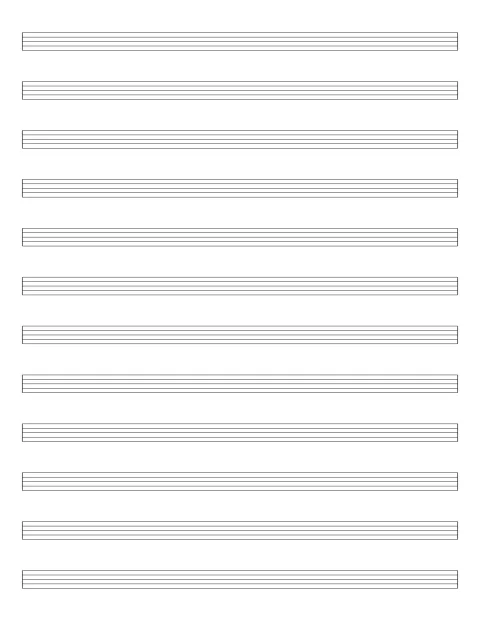
Drum music uses the familiar five-line staff, but the lines and spaces stand for instruments rather than pitches: kick drum low, snare in the middle, cymbals above the staff. The staff starts with a neutral clef, two short vertical bars, instead of a treble or bass clef. This paper prints those percussion staves ready to write on, or single-line staves for one unpitched instrument such as a snare drum, woodblock or tambourine.
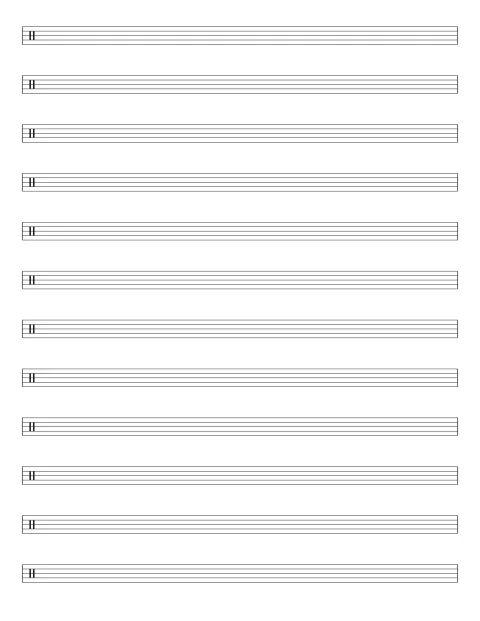
Preview of page 1. 215.9 mm × 279.4 mm. Print at 100% (“Actual size”) to keep the spacing exact.
What people use it for
- Writing drum kit grooves, fills and full transcriptions
- Snare drum and rudiment exercises on a single-line staff
- Marching band and drumline parts
- Classroom percussion parts for unpitched instruments
- Drum lessons where students copy patterns by hand
Standard measurements
| Clef | Neutral (percussion) clef for unpitched instruments |
|---|---|
| 5-line staff | Each line or space stands for a drum or cymbal, set by a key at the start of the piece |
| 1-line staff | One unpitched instrument per line |
| Default spacing | 2 mm between lines, 22 mm from staff to staff, both adjustable |
Tips for drum staff paper
- Choose the 5-line staff for drum kit or the single line for one instrument.
- Write a short key at the top of the page showing which line or space belongs to each drum and cymbal.
- Pick one symbol per instrument, for example a different note head for cymbals, and show it in your key.
- Increase the distance between staves if you add sticking (R and L) or dynamics.
- Print a few blank pages to keep in your stick bag for ideas.
Printing tip: in the print dialog choose Actual size or 100%, not “Fit to page”, or the spacing shrinks slightly. How we keep sizes exact.
Questions
What is a percussion clef?
It is the neutral clef, drawn as two short vertical bars. It tells the reader the staff is for unpitched instruments, so lines and spaces mean instruments, not notes.
Which line is the snare drum?
Placement varies between publishers and teachers, so drum parts usually start with a key that shows which line or space belongs to each drum and cymbal. Write your own key at the top of the page.
When should I use a single-line staff?
Use it for parts with one unpitched instrument, such as a snare, woodblock or triangle, where five lines would only get in the way.