RuledPaper
Free printable · PDF, PNG, SVG
Printable Fraction Strips (Fraction Wall)
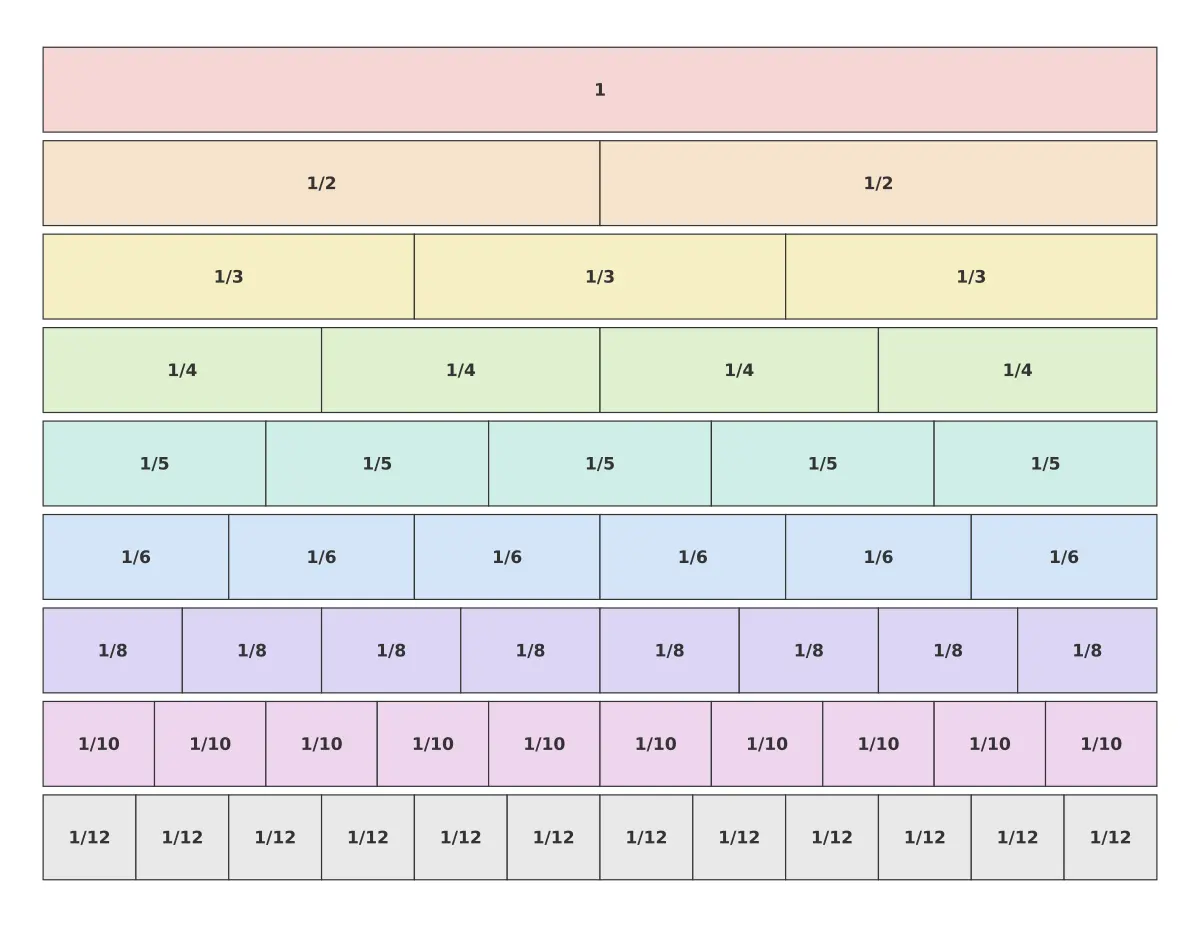
Fraction strips stack bars of equal length, each divided into a different number of equal parts: one whole, halves, thirds, quarters and so on down to twelfths. Seen together as a fraction wall, they make it easy to compare sizes and find equivalent fractions, because matching lengths line up vertically. Print the chart as a reference poster or cut the strips apart for hands-on lessons.
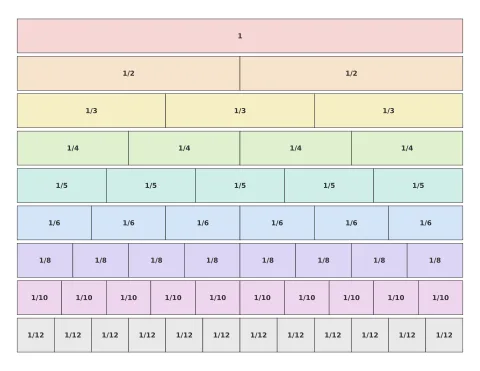
Preview of page 1. 279.4 mm × 215.9 mm. Print at 100% (“Actual size”) to keep the spacing exact.
What people use it for
- Comparing fractions such as 2/3 and 3/4
- Finding equivalent fractions like 1/2, 2/4 and 3/6
- Adding fractions with different denominators
- Hands-on math centers with cut-out strips
- Reference charts in workbooks and on classroom walls
Standard measurements
| Rows | One whole, then halves through twelfths |
|---|
Tips for fraction strips
- Print one copy as a full chart and another on card stock to cut into individual strips.
- Color each row in a different shade so pupils can sort the cut strips quickly.
- To compare two fractions, look down the wall: the piece that reaches further right is larger.
- To find equivalents, place a ruler vertically at the end of one fraction and read every row where a division line meets it.
- Change the line color to a darker shade if the sheet will be photocopied for a whole class.
Printing tip: in the print dialog choose Actual size or 100%, not “Fit to page”, or the spacing shrinks slightly. How we keep sizes exact.
Questions
What is a fraction wall?
It is a chart of stacked bars of equal length, each split into a different number of equal parts. It shows how fractions relate to one whole and to each other.
How do fraction strips show equivalent fractions?
Equal lengths line up. For example, the end of 1/2 lines up exactly with 2/4, 3/6, 4/8, 5/10 and 6/12, so they are all equivalent.
Why do the strips go up to twelfths?
Twelfths include halves, thirds, quarters and sixths as equal groups, so many common equivalences can be seen on one chart.
Is a larger denominator a larger fraction?
No, and the wall shows why: a bar cut into more parts has smaller pieces, so 1/8 is shorter than 1/4.