RuledPaper
Free printable · PDF, PNG, SVG
Polar Coordinate Graph Paper
Polar graph paper has concentric circles around a center point crossed by straight lines at equal angles, like a target divided into slices. Instead of x and y, each point is located by its distance from the center and its angle. Precalculus students use it for roses, cardioids and spirals, and designers use it to lay out dials, mandalas and radial patterns.
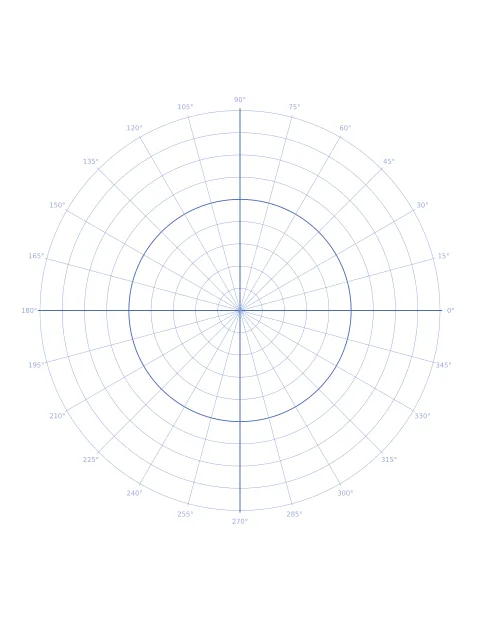
Preview of page 1. 215.9 mm × 279.4 mm. Print at 100% (“Actual size”) to keep the spacing exact.
What people use it for
- Graphing polar equations such as roses, cardioids and spirals
- Converting between polar and rectangular coordinates
- Designing clock faces, dials and gauges
- Mandalas, rose windows and radial art
- Antenna patterns and navigation bearings in physics and engineering
Standard measurements
| Full turn | 360 degrees = 2 pi radians |
|---|---|
| Point notation | (r, theta): distance from the pole, then angle from the polar axis |
Tips for polar graph paper
- Choose angle lines every 15 degrees (pi/12) for trigonometry homework, or every 30 degrees for simpler sketches.
- Measure angles counterclockwise from the line pointing right, the standard polar axis in math.
- For art and mandalas, pick a number of angle divisions that matches the symmetry you want, for example 8, 12 or 16.
- Print one polar grid per page for detailed curves and check the center is not cut off by your printer's margin.
Printing tip: in the print dialog choose Actual size or 100%, not “Fit to page”, or the spacing shrinks slightly. How we keep sizes exact.
Questions
How do I plot a point in polar coordinates?
Start at the center, turn to the given angle measured counterclockwise from the right-hand axis, then move out the given distance r along that line.
How do I convert polar to rectangular coordinates?
Use x = r cos theta and y = r sin theta. To go back, r is the square root of x squared plus y squared and theta comes from the tangent ratio y / x, adjusted for the quadrant.
Should I use degrees or radians?
Calculus and precalculus courses usually work in radians, while engineering and navigation often use degrees. One full turn is 360 degrees or 2 pi radians.
What shapes are drawn on polar paper?
Common examples are circles, cardioids (r = 1 + cos theta), rose curves (r = cos 3 theta) and Archimedean spirals (r = theta).