RuledPaper
Free printable · PDF, PNG, SVG
3D Coordinate Axes Paper
This sheet draws three axes, x, y and z, in an isometric layout over a matching grid, so you can sketch points, vectors and surfaces in three dimensions. It is useful in multivariable calculus, linear algebra, physics and engineering graphics, where freehand 3D axes quickly become inaccurate.
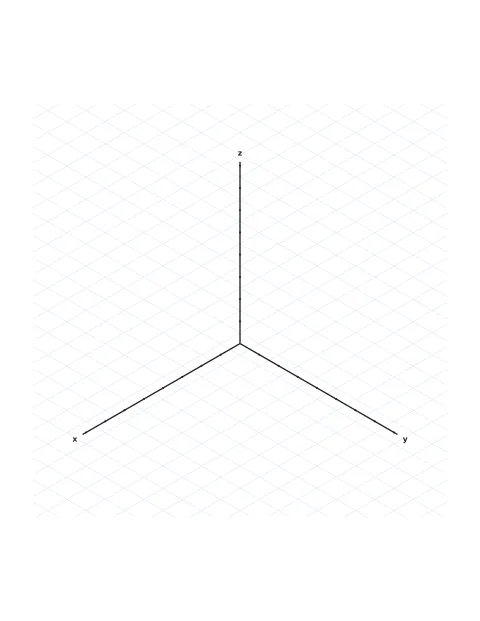
Preview of page 1. 215.9 mm × 279.4 mm. Print at 100% (“Actual size”) to keep the spacing exact.
What people use it for
- Plotting points (x, y, z) in multivariable calculus
- Drawing vectors and their components in physics
- Sketching planes, lines and simple surfaces
- Engineering graphics and technical sketching exercises
- Visualizing crystal structures and molecules in chemistry
Standard measurements
| Angle between axes on the page | 120 degrees (isometric view) |
|---|---|
| Scale | Equal along all three axes in true isometric projection |
Tips for 3d axes
- Follow the right-hand rule when labelling: point your fingers along x, curl them toward y, and your thumb shows the positive z direction.
- To plot a point, move along x, then parallel to y, then straight up parallel to z, and draw dashed guide lines so the depth is readable.
- Use the grid to keep vector lengths consistent; distances along each axis are drawn at the same scale.
- Print a few pages and keep one blank for practice before drawing the final answer for an assignment.
Printing tip: in the print dialog choose Actual size or 100%, not “Fit to page”, or the spacing shrinks slightly. How we keep sizes exact.
Questions
What is a 3D coordinate system?
It adds a third axis, z, at right angles to x and y. Every point is described by three numbers (x, y, z), its distance along each axis from the origin.
Why are the axes drawn 120 degrees apart?
In an isometric view the three perpendicular axes appear 120 degrees apart and all at the same scale, so equal lengths in space look equal on paper.
What is the right-hand rule?
It fixes the direction of the axes: with your right hand, fingers along positive x and curling toward positive y, your thumb points along positive z.
Can I draw planes on this paper?
Yes. Find where the plane crosses each axis, mark the three points, and join them to draw the triangle of the plane in the first octant.