RuledPaper
Free printable · PDF, PNG, SVG
Printable Coordinate Plane (X and Y Axes)
A coordinate plane is graph paper with a horizontal x-axis and vertical y-axis drawn in and numbered, so students can plot points straight away. It is used from the first lessons on ordered pairs through linear equations, transformations and functions in high school. Print a single large plane for detailed work or several smaller ones for practice worksheets.
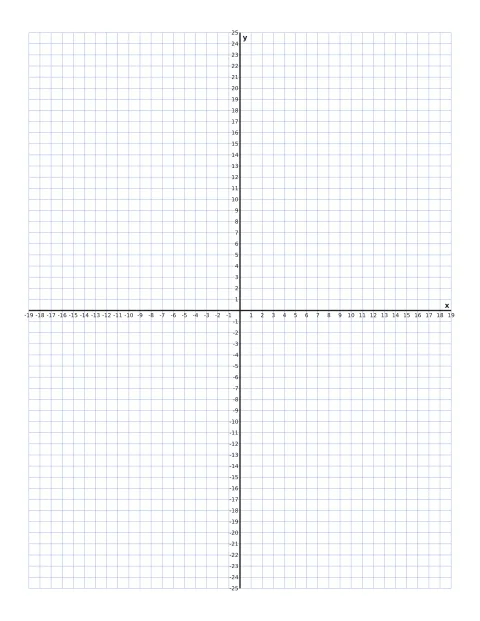
Preview of page 1. 215.9 mm × 279.4 mm. Print at 100% (“Actual size”) to keep the spacing exact.
What people use it for
- Plotting ordered pairs and naming quadrants
- Graphing linear equations, slopes and intercepts
- Reflections, rotations and translations in geometry
- Sketching parabolas and other functions
- Mystery picture activities where plotted points form a drawing
Standard measurements
| Quadrants | Four, numbered I to IV counterclockwise from the upper right |
|---|---|
| Ordered pair | (x, y): horizontal value first, vertical value second |
Tips for coordinate plane
- Use a 1/4 in or 5 mm grid for full-page graphs and a larger 1 cm grid for younger students who are still learning to count units.
- Decide the range before printing: a plane from -10 to 10 on each axis suits most middle school problems.
- Print several small planes per page for homework sets where each problem needs its own graph.
- Teach students to label the axes and mark the scale first; many graphing mistakes come from skipped or uneven scales.
Printing tip: in the print dialog choose Actual size or 100%, not “Fit to page”, or the spacing shrinks slightly. How we keep sizes exact.
Questions
What are the four quadrants?
Quadrant I has positive x and y, quadrant II negative x and positive y, quadrant III both negative, and quadrant IV positive x and negative y. They are numbered counterclockwise starting at the upper right.
Which number comes first in a coordinate pair?
The x value comes first and tells you how far to move left or right; the y value comes second and tells you how far to move up or down.
What is the origin?
The origin is the point (0, 0) where the x-axis and y-axis cross. Every point is located by its distance from the origin along each axis.
Can I print a coordinate plane without numbers?
If you need a blank grid for students to label themselves, use the graph paper page and draw the axes by hand.