RuledPaper
Free printable · PDF, PNG, SVG
Printable Multiplication Chart
A multiplication chart is a grid with numbers along the top and left side and every product filled in where a row meets a column. Children use it to learn times tables, spot patterns and check homework. Teachers print large copies for the wall and small ones for desks and folders.
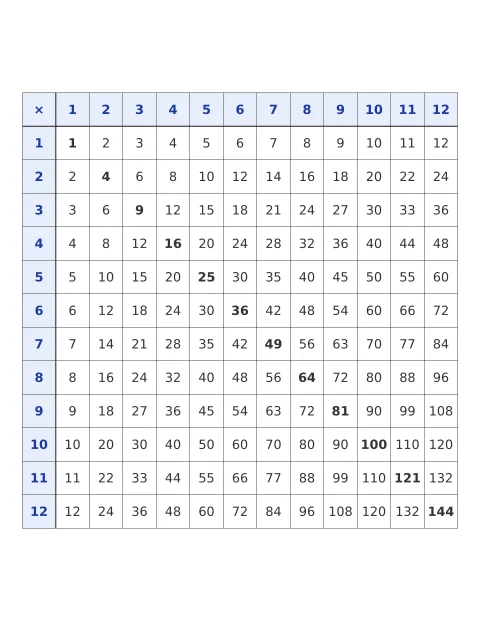
Preview of page 1. 215.9 mm × 279.4 mm. Print at 100% (“Actual size”) to keep the spacing exact.
What people use it for
- Learning and reviewing times tables in grades 2 to 5
- Desk reference while practicing long multiplication and division
- Finding factors, multiples and square numbers
- Pattern lessons: even numbers, diagonals and symmetry
- Wall posters for classrooms and homework corners
Standard measurements
| 1 to 10 chart | 100 products |
|---|---|
| 1 to 12 chart | 144 products, used where 12 times tables are taught |
Tips for multiplication chart
- Start with a 1 to 10 chart for younger children; switch to 1 to 12 once the 10s are solid if your school teaches the 11 and 12 times tables.
- To find 7 x 8, run a finger along row 7 and down column 8; the square where they meet holds 56.
- Highlight the square numbers on the diagonal and show that the chart is mirrored across it, so there are far fewer facts to learn than it seems.
- Print an A3 copy for the wall and Letter or A4 copies for each child's folder.
Printing tip: in the print dialog choose Actual size or 100%, not “Fit to page”, or the spacing shrinks slightly. How we keep sizes exact.
Questions
Why do some charts go to 12?
Twelve times tables are traditional in many English-speaking schools, a habit linked to dozens, 12 inches in a foot and old currency. A 1 to 12 chart covers both the 10 x 10 and 12 x 12 conventions.
How many facts do children really need to memorize?
Because 3 x 7 equals 7 x 3, half the chart repeats. On a 12 x 12 chart there are 78 unique facts, and the 1s and 10s are easy, leaving far fewer to practice.
What patterns can children find on the chart?
Every number in the 5s column ends in 0 or 5, the 9s digits add up to 9 up to 9 x 10, and the square numbers run along the diagonal from top left to bottom right.
Is using a chart cheating?
No. A chart is a learning tool: looking up facts repeatedly helps memorize them, and it lets children focus on the method when solving harder problems.