RuledPaper
Free printable · PDF, PNG, SVG
Wavy Line Paper
Wavy line paper replaces straight rules with smooth repeating waves. Preschool teachers and occupational therapists use it as a pre-writing exercise, because following a curve builds the wrist control that letters such as s, c and u require later. Crafters and stationery fans also print it as a playful background for notes, cards and scrapbook pages.
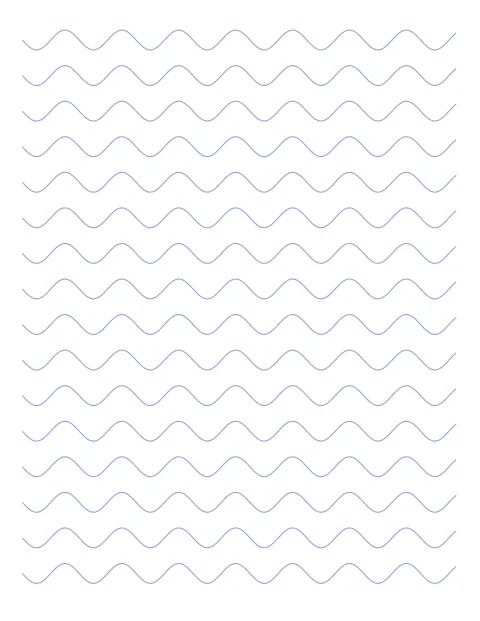
Preview of page 1. 215.9 mm × 279.4 mm. Print at 100% (“Actual size”) to keep the spacing exact.
What people use it for
- Pre-writing tracing for toddlers and preschoolers with a crayon or marker
- Fine motor exercises in occupational therapy sessions
- Decorative letter paper and invitation backgrounds
- Scrapbook and junk journal backing sheets
- Warm-up strokes for brush pen and lettering practice
Tips for wavy lines
- For small children choose large, slow waves with wide spacing and a thick line weight so the path is easy to see and follow.
- Make waves smaller and closer as the child improves, which turns the same sheet into a harder exercise.
- Ask children to trace from left to right without lifting the crayon, just as they will later write a line of text.
- For decorative use, select a soft color and thin weight so the waves stay in the background behind your writing.
Printing tip: in the print dialog choose Actual size or 100%, not “Fit to page”, or the spacing shrinks slightly. How we keep sizes exact.
Questions
Why do preschoolers trace wavy lines?
Tracing curves builds hand-eye coordination and controlled wrist movement. These are the same skills children need for round letters, so wavy lines are a common step before formal handwriting.
What should a child use to trace?
Thick crayons, triangular pencils or washable markers are easier to grip than thin pencils. Laminate the sheet or put it in a sheet protector to reuse it with dry-erase markers.
Can I write normal text on wavy paper?
You can, but it works better as decoration or as a tracing exercise. For writing, keep the waves shallow and the spacing at least as wide as normal ruled paper.
Which paper size should I pick?
Use Letter or A4 for most practice. A5 makes small cards, and A3 is handy for whole-arm tracing at a table or on a wall.