RuledPaper
Free printable · PDF, PNG, SVG
Divergent (Fan-Out) Guide Lines
Divergent line paper has rules that start close together on one side and spread apart toward the other, like the edge of a fan. Lettering artists use it to draw words that seem to grow or rush toward the viewer, and illustrators use it as a quick perspective guide for banners, roads and signs. The sheet removes the need to rule each converging line by hand.
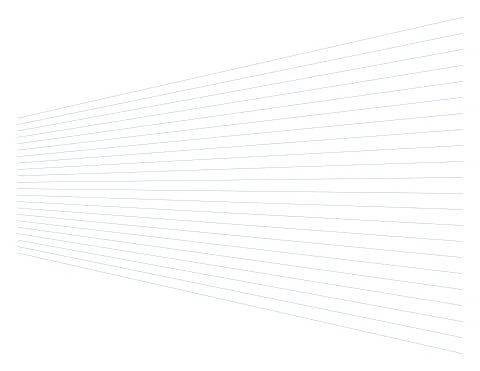
Preview of page 1. 279.4 mm × 215.9 mm. Print at 100% (“Actual size”) to keep the spacing exact.
What people use it for
- Lettering that grows from small to large across a poster or cover
- Comic sound effects and title text with a sense of speed
- Ribbon and banner text that recedes into the distance
- Sketching roads, rails and fences in rough perspective
- Graphic design layouts that need dynamic diagonal energy
Tips for divergent lines
- Decide which side should hold the small end of your text and set the orientation so the lines widen in the direction you read.
- Use landscape on A3 or Letter for long words; the extra width gives the lines room to spread without crowding the narrow end.
- Draw the letters with their tops and bottoms touching a pair of lines, and keep vertical strokes upright or aimed at the same vanishing point.
- Print in a light color so the guides disappear behind your inked lettering when you scan or photograph the result.
Printing tip: in the print dialog choose Actual size or 100%, not “Fit to page”, or the spacing shrinks slightly. How we keep sizes exact.
Questions
What are divergent lines in lettering?
They are guide lines that are not parallel: they spread apart from one end of the page to the other. Letters drawn between them get taller as they go, which creates a perspective or zoom effect.
How is this different from a perspective grid?
A perspective grid places lines that meet at a vanishing point for drawing whole scenes. Divergent lines are simpler: a set of fanning writing guides meant mainly for text and single shapes.
Can I trace through the printed sheet?
Yes. Print with dark lines, place the sheet under thin marker or layout paper, and letter on top without marking the guide itself.
Which paper size works best?
A3 landscape gives the most dramatic spread for posters. A4 or Letter is enough for practice and for planning a design before you scale it up.