RuledPaper
Free printable · PDF, PNG, SVG
Calligraphy Slant Line Guide Sheets
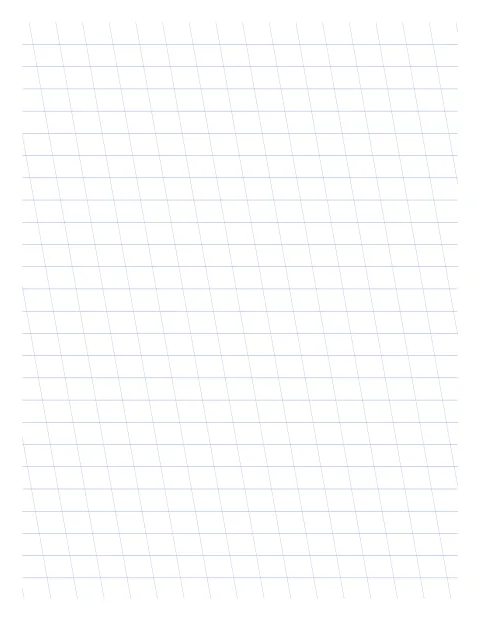
Slanted line paper combines horizontal writing lines with diagonal guides that show the angle every downstroke should follow. Pointed pen calligraphers use it to learn Copperplate and Spencerian, and anyone practicing a sloped cursive hand uses it to train a consistent lean. The default angle is 55 degrees from the baseline, which matches the usual Copperplate guide, and you can change it in one step.
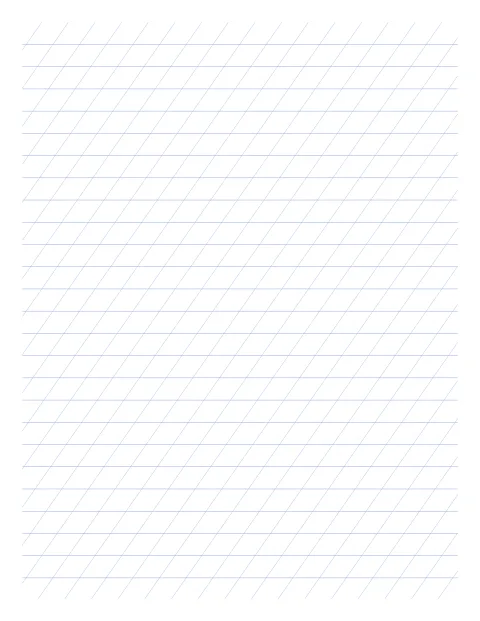
Preview of page 1. 215.9 mm × 279.4 mm. Print at 100% (“Actual size”) to keep the spacing exact.
What people use it for
- Copperplate and Engrosser's script drills with a pointed pen
- Spencerian practice at a slightly steeper slant
- Modern brush lettering where you want a gentle, even lean
- Training a consistent slope in everyday cursive handwriting
- Placing under a translucent layout pad as a reusable guide
Standard measurements
| Copperplate slant | 55 degrees from the baseline |
|---|---|
| Spencerian main slant | 52 degrees, with a 30 degree connective slant |
Tips for slanted lines
- Set the angle first: 55 degrees for Copperplate, 52 degrees for Spencerian, or a steeper value close to 90 for a hand that leans only slightly.
- Choose the line spacing from your nib and the size you want to write. Beginners usually learn faster with a larger x-height, around 8 to 10 mm (about 3/8 in), and shrink it later.
- Keep the slant lines thinner or lighter than the writing lines so your eye reads them as guides rather than as part of the letters.
- If you write on fine calligraphy paper that does not go through your printer, print the guide with darker lines and place it underneath as a lightbox sheet.
Printing tip: in the print dialog choose Actual size or 100%, not “Fit to page”, or the spacing shrinks slightly. How we keep sizes exact.
Questions
What angle is Copperplate calligraphy written at?
Copperplate guide sheets are normally ruled at 55 degrees from the baseline. Spencerian uses a slightly steeper slant of 52 degrees for its main strokes, plus a 30 degree slant for some connecting strokes.
Is the angle measured from the baseline or from vertical?
On this page the angle is measured from the horizontal baseline, so 90 degrees is upright. Some guide generators measure from vertical instead, in which case 55 degrees from the baseline equals 35 degrees from vertical.
Can I use slant guides for italic handwriting?
Yes. Italic leans only a few degrees from upright, so enter an angle close to 90. The slant lines then act as a gentle reminder to keep every letter at the same tilt.
Why do my letters still look uneven with guidelines?
Guides only help if every downstroke runs parallel to them. Slow down, check each stroke against the nearest slant line, and practice single strokes in rows before writing full words.