RuledPaper
Free printable · PDF, PNG, SVG
Printable Hundred Chart (1 to 100)
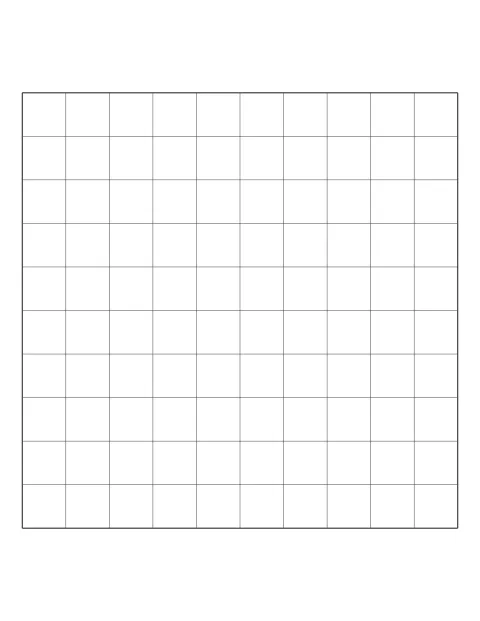
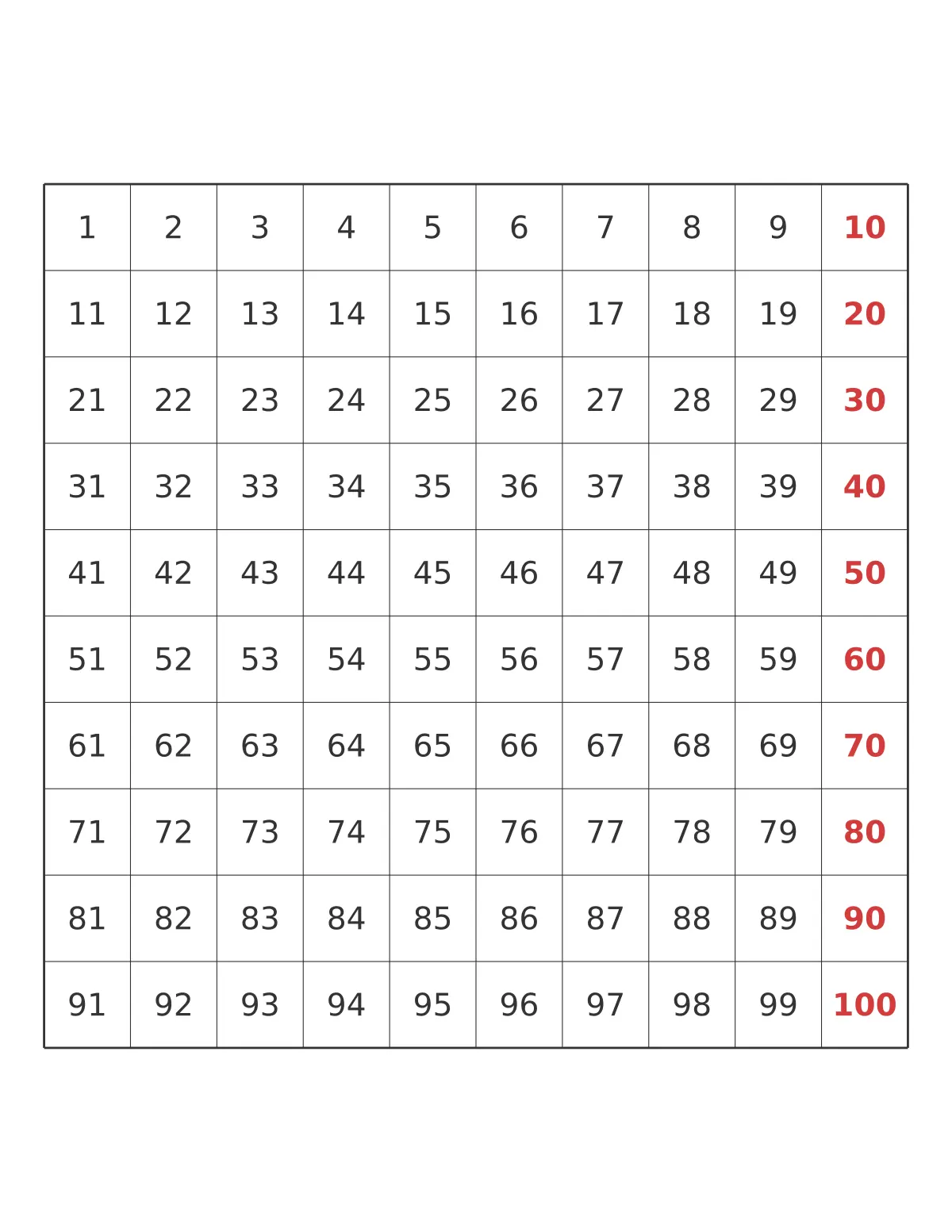
A hundred chart is a 10 by 10 grid with the numbers 1 to 100 arranged in rows of ten. Because each row starts a new ten, patterns in our base ten number system become visible at a glance: every number in a column ends in the same digit, and moving down one row adds ten. Print it filled in as a reference, or blank so pupils write the numbers themselves and discover the patterns along the way.
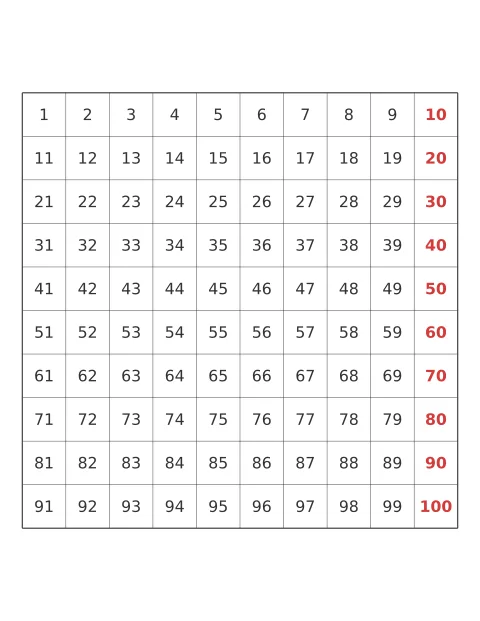
Preview of page 1. 215.9 mm × 279.4 mm. Print at 100% (“Actual size”) to keep the spacing exact.
Ready-made hundred chart presets
What people use it for
- Counting to 100 in kindergarten and first grade
- Skip counting by 2s, 5s and 10s with colored pencils
- Adding and subtracting tens by moving up and down
- Finding multiples and spotting number patterns
- Missing number puzzles using the blank version
Standard measurements
| Grid | 10 x 10 squares, 100 cells |
|---|---|
| Variants | Filled with 1 to 100, or blank |
Tips for hundred chart
- Choose the filled variant for a desk reference or wall poster, and the blank variant for practice and assessment.
- For skip counting, ask pupils to color every second, fifth or tenth number and describe the stripes and columns that appear.
- To add 10, move down one row; to subtract 10, move up one row. To add 1, move one square right.
- Cut a filled chart into puzzle pieces and let children rebuild it, which reinforces number order.
- Print on A3 or Tabloid for a large classroom version, or put several small charts on a page by printing at reduced size.
Printing tip: in the print dialog choose Actual size or 100%, not “Fit to page”, or the spacing shrinks slightly. How we keep sizes exact.
Questions
What is a hundred chart used for?
It helps children count to 100, see place value, practice skip counting and add or subtract tens. Because the numbers are arranged in rows of ten, many patterns are easy to spot.
How can a hundred chart help with addition?
To add 23 and 15, start on 23, move down one row for the ten to reach 33, then five squares right to land on 38. The moves mirror adding tens and ones.
Should the chart start at 0 or 1?
This chart runs from 1 to 100, so each row ends on a multiple of ten. Some classrooms prefer a 0 to 99 chart, where every row starts with a new tens digit.
How do I use the blank version?
Ask pupils to fill in all the numbers, or write a few clues in random squares and have them complete the rest. It quickly shows who understands the pattern.