RuledPaper
Free printable · PDF, PNG, SVG
One-Point Perspective Grid
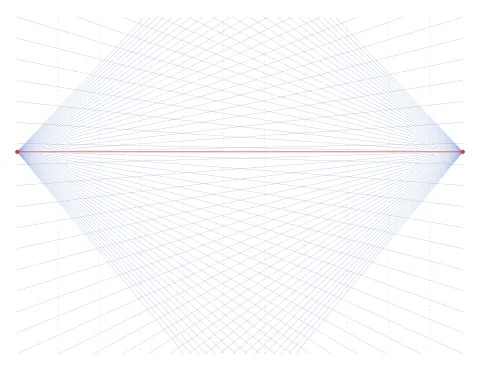
A one-point perspective grid draws lines that all run to a single vanishing point on the horizon, plus horizontal and vertical lines that stay parallel to the page. It is the first perspective system taught in art class because it is easy to read: think of looking straight down a corridor, a road or a train track. Use the grid as an underlay and your boxes, doors and windows line up correctly.
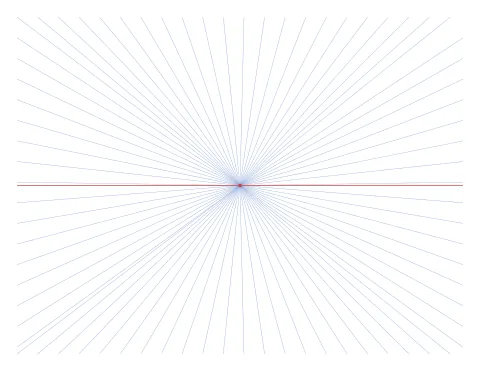
Preview of page 1. 279.4 mm × 215.9 mm. Print at 100% (“Actual size”) to keep the spacing exact.
What people use it for
- Art class exercises on rooms, hallways and streets
- Interior design sketches seen from the front of a room
- Comic panels and storyboards with deep backgrounds
- Stage and set design thumbnails
- Lettering that recedes into the distance
Tips for one-point perspective
- Place the vanishing point at eye level. A low horizon makes a scene feel tall and imposing; a high one gives a looking-down view.
- Draw the front faces of objects as true rectangles, then connect each corner to the vanishing point to find the sides.
- Use landscape orientation for street and room scenes, since most one-point views are wider than they are tall.
- Print the grid in light blue and ink over it, or place it under tracing paper and keep the guide for the next drawing.
Printing tip: in the print dialog choose Actual size or 100%, not “Fit to page”, or the spacing shrinks slightly. How we keep sizes exact.
Questions
What is one-point perspective?
It is a drawing method where all lines going into depth meet at one vanishing point on the horizon, while widths and heights stay horizontal and vertical. It works best when you face a scene head on.
Where should the vanishing point be?
It sits on the horizon line at the viewer's eye level. Centered gives a symmetrical, formal view; moving it to one side makes the scene feel more natural.
When should I use two-point perspective instead?
Use two-point when you look at an object from a corner, such as a building seen from the street corner. Each set of side walls then has its own vanishing point.
Can I draw on the printed grid directly?
Yes. With a light line color and thin weight the grid fades behind pencil and ink, so you can draw right on it.