RuledPaper
Free printable · PDF, PNG, SVG
Sphere Drawing Guide with Latitude and Longitude Lines
This sheet draws spheres wrapped in curved latitude and longitude lines, like a wireframe globe. The lines show how a flat pattern bends around a round form, which is one of the hardest ideas for beginning artists. Use it to practice shading, wrap patterns around balls and heads, or teach the basics of the globe in geography.
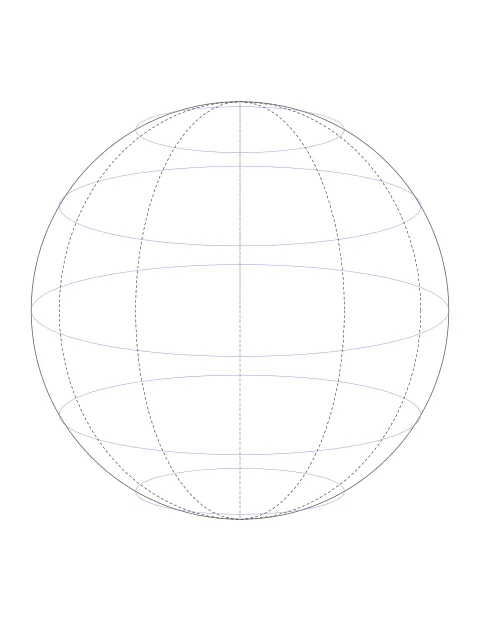
Preview of page 1. 215.9 mm × 279.4 mm. Print at 100% (“Actual size”) to keep the spacing exact.
What people use it for
- Shading practice for light, shadow and core shadow on a sphere
- Learning to wrap stripes and textures around round forms
- Head and skull construction sketches for portrait drawing
- Geography lessons on latitude, longitude and the equator
- Planets, balls and ornaments in illustrations
Tips for sphere guide
- Pick one light direction, mark it with an arrow, and shade each band between the latitude lines a little darker as it turns away from the light.
- Follow the curved lines when drawing patterns such as stripes on a beach ball; they show how lines compress near the edge.
- Use larger spheres on A3 or Letter landscape for shading studies, and smaller ones for quick daily warm-ups.
- Draw your own sphere freehand next to the guide and compare where the curves bend.
Printing tip: in the print dialog choose Actual size or 100%, not “Fit to page”, or the spacing shrinks slightly. How we keep sizes exact.
Questions
What are latitude and longitude lines?
Latitude lines run around the globe parallel to the equator. Longitude lines, or meridians, run from pole to pole. Together they form the grid used to locate places on Earth.
Why do lines on a sphere look curved?
A sphere turns away from you on every side, so circles drawn on its surface appear as ellipses and arcs that get flatter toward the edges.
How do I shade a sphere realistically?
Find the highlight facing the light, a gradual midtone, a darker core shadow, then a slightly lighter edge from reflected light, plus a cast shadow on the ground.
Can I use it for drawing heads?
Yes. Many portrait methods start from a sphere for the cranium; the guide lines help you place the brow and center line as the head turns.