RuledPaper
Free printable · PDF, PNG, SVG
Cone Net Template
A cone net is a flat circular sector that rolls up into a cone, usually with a separate circle for the base. Teachers use it to show how surface area is calculated, and crafters use it for party hats, paper Christmas trees, cone gift boxes and witch hats. Print it at the size you need and cut along the curve.
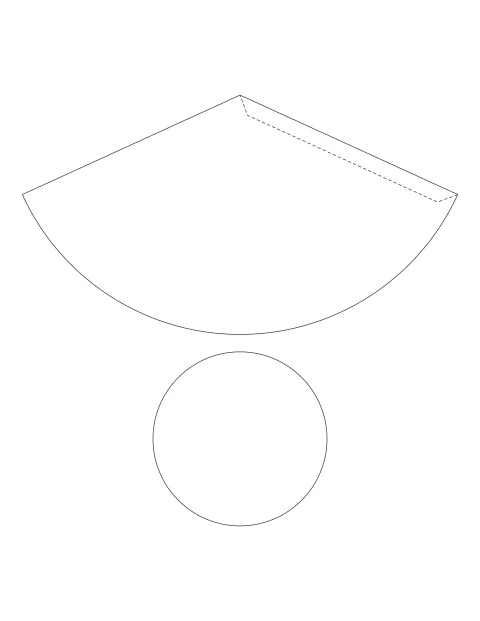
Preview of page 1. 215.9 mm × 279.4 mm. Print at 100% (“Actual size”) to keep the spacing exact.
What people use it for
- Math lessons on cone surface area and volume
- Party hats and costume hats
- Paper Christmas trees and table decorations
- Cone shaped treat and popcorn holders
- Model rocket nose cones and scale models
Standard measurements
| Sector angle | 360 degrees x base radius / slant height |
|---|---|
| Slant height | Square root of (base radius squared + height squared) |
| Curved surface area | Pi x base radius x slant height |
Tips for cone net
- Work out the base diameter and height of the finished cone first. The slant height follows from them and sets the radius of the curved edge.
- Add a narrow glue tab along one straight edge before cutting, or overlap the edges by about 1 cm (3/8 in).
- Use A3 for party hats and larger decorations; a typical child's hat is wider than an A4 sheet can hold flat.
- Curl the paper gently over a table edge before gluing so the cone forms smoothly without creases.
Printing tip: in the print dialog choose Actual size or 100%, not “Fit to page”, or the spacing shrinks slightly. How we keep sizes exact.
Questions
How do I calculate a cone net?
Find the slant height with Pythagoras from the base radius and height. The net is a circle sector with radius equal to the slant height and an angle of 360 x radius / slant height degrees.
What is the surface area of a cone?
The curved surface is pi x r x s, where r is the base radius and s is the slant height. Add pi x r squared if the cone has a closed base.
What paper works best for party hats?
Thin card stock bends smoothly yet holds its shape. Very thick card cracks when curved tightly, so test a small cone first.
Why does my cone come out too flat or too pointed?
The sector angle controls the shape. A smaller angle gives a tall, narrow cone, and a larger angle gives a short, wide one. Overlapping the edges more also makes the cone narrower.