RuledPaper
Free printable · PDF, PNG, SVG
Cube Template for Paper Craft and Drawing
This template helps you build and draw cubes. Fold a printed net into a real paper cube for math class, dice, gift boxes and models, or use the cube outlines to practice drawing boxes, the foundation of almost every drawing course. Set the size and the template scales accurately to the paper you choose.
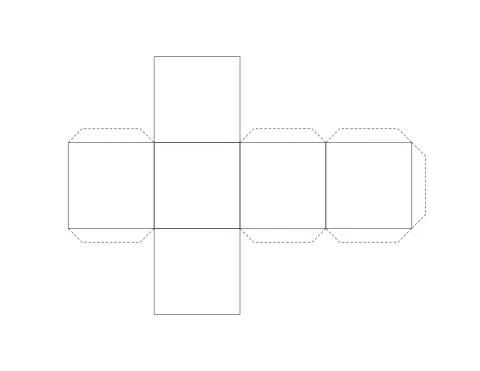
Preview of page 1. 279.4 mm × 215.9 mm. Print at 100% (“Actual size”) to keep the spacing exact.
What people use it for
- Math lessons on nets, faces, edges and vertices
- Homemade dice and learning cubes with words or numbers
- Small gift boxes and party favors
- Box drawing exercises for artists
- Building blocks for paper models and dioramas
Tips for cube
- Choose the edge length from the finished cube: a 5 cm (about 2 in) cube fits comfortably on A4 or Letter with room for glue tabs.
- Print on card stock so the cube holds its shape; plain copy paper works for quick classroom models.
- Score the fold lines with a ruler and a dry ballpoint pen before folding; the edges will be straight and crisp.
- For drawing practice, trace the guide boxes, then try the same box from memory next to it.
- To make dice, write the numbers so opposite faces add up to seven before you fold: 1 opposite 6, 2 opposite 5 and 3 opposite 4.
Printing tip: in the print dialog choose Actual size or 100%, not “Fit to page”, or the spacing shrinks slightly. How we keep sizes exact.
Questions
How many different nets does a cube have?
A cube has 11 distinct nets, not counting rotations and reflections. The cross shape is the most familiar, but ten others fold into the same cube.
How many faces, edges and vertices does a cube have?
A cube has 6 square faces, 12 edges and 8 vertices. This fits Euler's formula for polyhedra: vertices minus edges plus faces equals 2.
What paper is best for a sturdy paper cube?
Use card stock. Plain printer paper folds easily but crushes, while card stock holds sharp edges and survives play as dice or blocks.
Why practice drawing cubes?
Most objects can be simplified into boxes. Drawing cubes from different angles trains perspective, proportion and line control at the same time.