RuledPaper
Free printable · preset
Capital Letter Tracing Worksheet
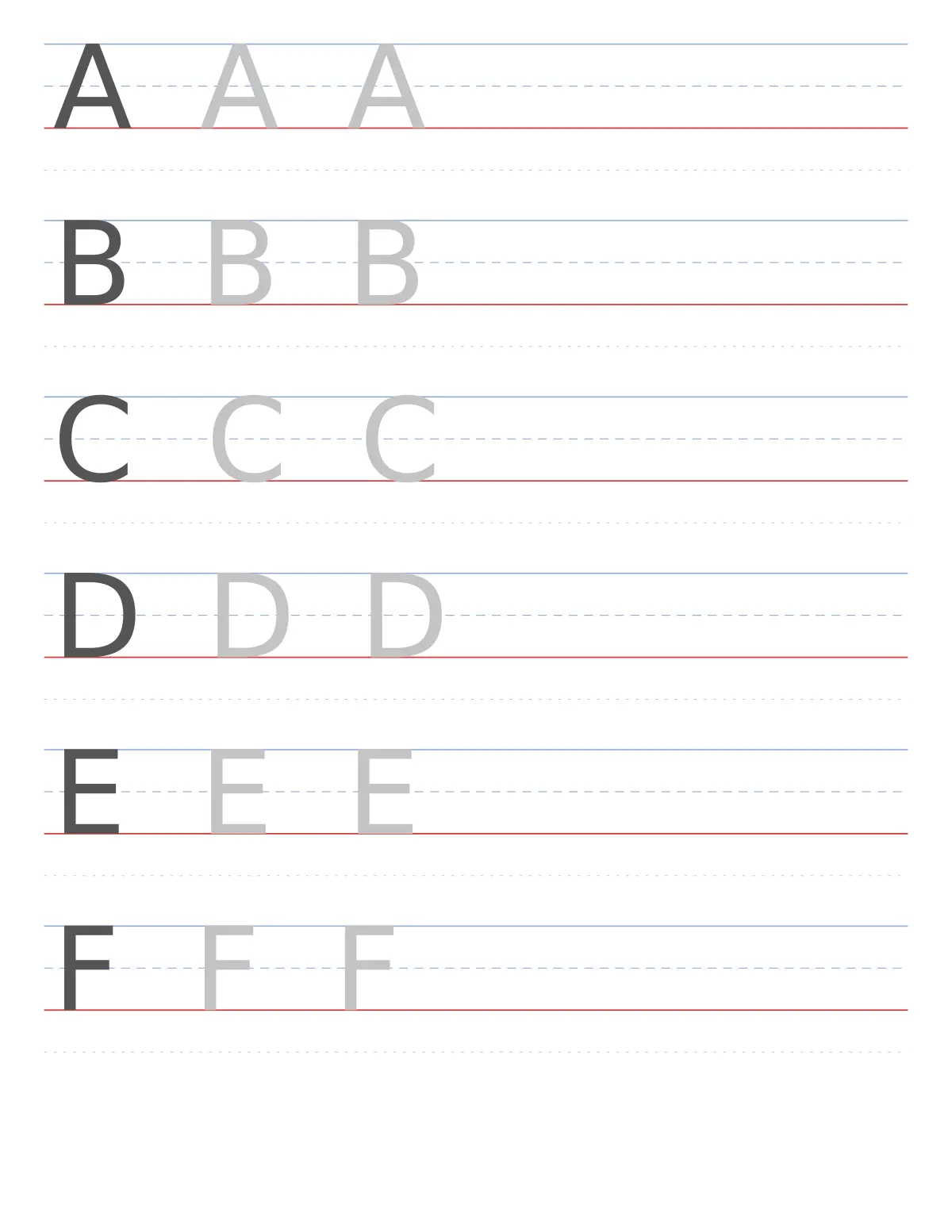
This sheet uses capital letters only. Each row is a handwriting band with a top line, a dashed midline and a baseline, starting with a model letter in dark gray followed by lighter copies to trace, then blank space on the right to write the letter independently. Rows move through the alphabet, and each new page continues from a later letter. Capitals are built from straight lines and simple curves, which makes them a common first step. The generator opens with capitals selected, and line height, colors and every other option can still be changed.
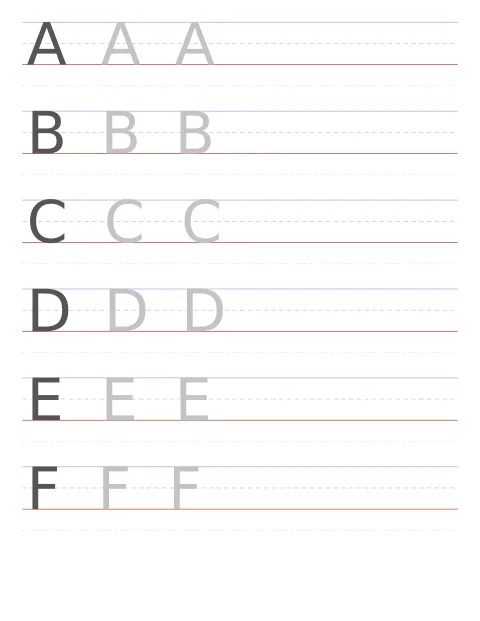
Preview of page 1. 215.9 mm × 279.4 mm. Print at 100% (“Actual size”) to keep the spacing exact.
Tips for this setting
- Point out that capitals stretch from the top line all the way to the baseline; none stop at the dashed midline.
- Teach the stroke order for each letter aloud, for example for E: down, then the three lines from left to right, top to bottom.
- Keep the default 3/4 inch line height for preschool and kindergarten; reduce it as control improves.
- Print several pages in one go to cover the whole alphabet, since each page starts from a different letter.
Preschool teachers and parents use the capitals sheet first because many children learn to write their name in capital letters before anything else. It also helps older children who still mix up the size of capitals and lowercase letters in the same word.
Every option above can still be changed. For the full guide to alphabet practice, see the alphabet practice page.
Settings on this page
| Setting | Value | Set by |
|---|---|---|
| Paper size | US Letter in the US and Canada, A4 everywhere else (from your browser language) | Alphabet practice default |
| Orientation | Portrait | Alphabet practice default |
| Margin | 10 mm (0.394 in) on every side | Alphabet practice default |
| Line height | 19.05 mm (0.75 in) | Alphabet practice default |
| Style | Capitals | This preset |
| Line weight | 0.20 mm | Alphabet practice default |
| Name and date line | Off | Alphabet practice default |
This page changes the style from the standard alphabet practice settings. Paper size, orientation and margin sit in the Paper panel of the generator; the other settings are in the Alphabet practice panel. The address bar updates as you change them, so you can bookmark or share your own version.
Printing it at the right size
US Letter is 215.9 × 279.4 mm and A4 is 210 × 297 mm. Choose the size that is in your printer under Size before you download, because a print dialog that fits a Letter page onto A4 scales it to about 97%, and A4 onto Letter to about 94%.
Exact size matters here. If a print dialog fits A4 onto US Letter (about 94%), the line height of 19.05 mm prints as 17.92 mm. Choose "Actual size" or "Scale 100%", then check one measurement on the printout with a ruler.
Questions
Should capital letters touch the midline?
No. Capital letters are full height, from the top line down to the baseline. The dashed midline is a guide for lowercase letters such as a, c and e.
Which capital letters are easiest to start with?
Letters made only of straight lines, such as L, T, F, E, H and I, are usually easiest. Curved and diagonal letters like S, G, K and Z come later.
Should children learn capital or lowercase letters first?
Approaches differ. Many programs start with capitals because their straight lines are easier to form, then move to lowercase, which children see far more often in books. Others teach both together. Follow the order your child's school uses so practice at home matches the classroom.